

SkyTab vs Oracle MICROS: Which POS System Is Right for Your Restaurant in 2025?
SkyTab wins for independent restaurants and small chains seeking fast deployment, transparent pricing, and integrated payments. Oracle MICROS (Simphony) dominates enterprise hospitality — hotels, multi-brand groups, and high-volume operations requiring deep customization and centralized control across hundreds of properties.
"I've installed both systems in real-world restaurant environments — from single-location cafés to 50+ unit chains. SkyTab gets you live in days with zero surprises on cost. MICROS delivers enterprise-grade power, but you pay for complexity you may not need. Choose based on your actual scale and tolerance for IT overhead, not vendor promises."
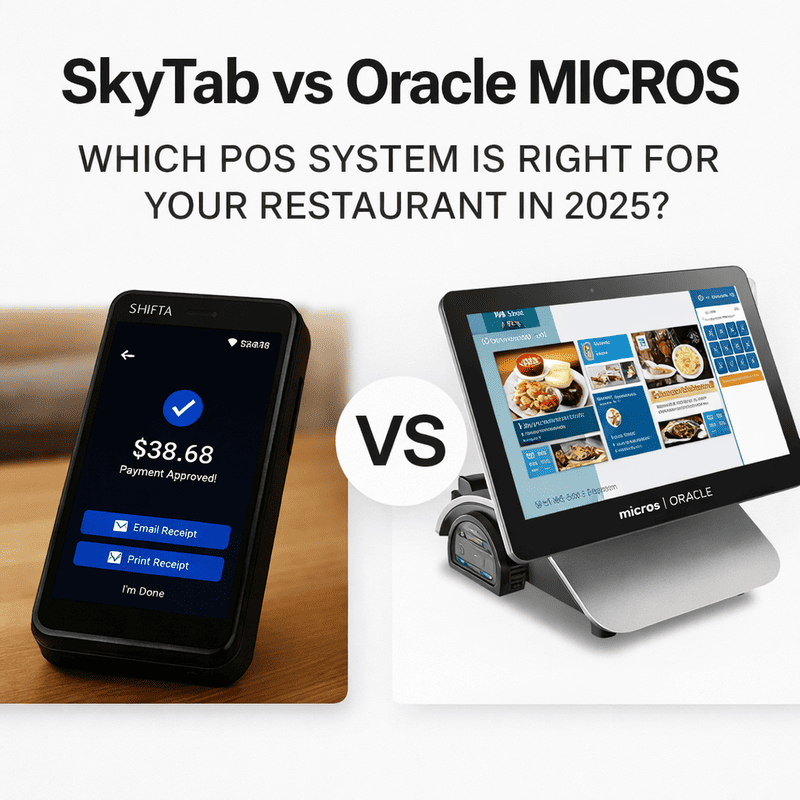
Side-by-Side: SkyTab vs MICROS Simphony (2025 Comparison Table)
| Criterion | SkyTab (Shift4) | MICROS Simphony (Oracle) |
|---|---|---|
| Deployment Type | Cloud-native SaaS with offline transaction caching. Zero on-prem servers, automatic updates, web-based admin. Fast scaling through browser console. | Hybrid/local architecture with cloud modules. On-prem servers optional; supports air-gapped deployments. Enterprise policies and compliance controls. |
| Target Business | Independent restaurants, coffee shops, bars, fast-casual, pizzerias, 1–20 location regional chains. Operators valuing speed over customization. | Hotels, resorts, casinos, stadiums, multi-brand restaurant groups, 100+ properties. Complex hierarchies, centralized control, regulatory compliance. |
| Ease of Use | Intuitive tablet UI optimized for rapid staff onboarding. Tableside handhelds reduce training time; most teams live in 2–3 days. Minimal IT dependency. | Steeper learning curve due to extensive configuration options. Requires admin training for role setup, menu engineering, and multi-property synchronization. |
| Integrations | Core SMB stack: delivery aggregators (DoorDash, Uber Eats, Grubhub), QuickBooks/Xero, basic loyalty/CRM. Open API for custom builds. | Extensive Oracle ecosystem: ERP (NetSuite, SAP), PMS (OPERA), BI tools, advanced labor/inventory platforms. Certified partner network for deep integrations. |
| Support Model | 24/7/365 Shift4 in-house support with nationwide on-site technicians. Single vendor for POS, payments, and hardware. Clear SLA for SMBs. | Oracle Premier Support with tiered enterprise SLAs. 24/7 global coverage, dedicated account managers for large deployments. Higher-cost premium tiers. |
| Reporting & Analytics | Real-time sales dashboards, shift summaries, menu performance, mobile owner analytics. Sufficient for single/multi-location ops without BI complexity. | Multi-dimensional BI reports, centralized KPIs, cross-property benchmarking. Drill-down guest check analysis, compliance audits, labor variance tracking. |
Bottom line: SkyTab = fast, transparent, sufficient. MICROS = deep, scalable, complex. Choose based on whether you need “good enough quickly” or “exactly tailored slowly.”
Total Cost of Ownership: SkyTab vs MICROS (Pricing Breakdown)
Hardware: Upfront Investment and Lifecycle Costs
SkyTab
Factory-configured terminals and handhelds subsidized when using Shift4 processing — often $0 upfront for qualified merchants. Bundles include dock stations, receipt printers, and cash drawers. Lifetime hardware warranty eliminates 3–5 year replacement cycles common in legacy systems.
Total hardware TCO over 3 years: approximately $600–1,200 per workstation (minimal capex, mostly accessories).
Subsidy qualification depends on merchant approval, processing volume commitments, and contract length; consult Shift4 sales for eligibility criteria.
MICROS
Enterprise-certified terminals, tablets, and peripherals engineered for intensive hospitality use. Higher upfront cost: estimated $1,500–3,000 per workstation depending on configuration. Durability tested for spillage/drops, but no standard lifetime warranty. Replacement cycles every 5–7 years.
For a 20-location chain (100 terminals): hardware alone estimated $150K–300K initial investment.
Oracle pricing varies significantly by deployment scale and contract negotiation; direct quotes required.
Verdict: SkyTab wins on low-touch hardware economics. MICROS justifies higher cost through certified durability in extreme-use environments (stadiums, casinos).
Software Licensing: Subscription vs. Enterprise Contracts
SkyTab: Per-workstation subscription model covering POS software, cloud hosting, automatic updates, and core features (online ordering, loyalty, KDS integration). No tiered upsells for essentials. Add-ons (advanced analytics, multi-location dashboards) priced transparently.
MICROS: Tiered licensing with pricing opacity — requires direct Oracle sales quote. Enterprise contracts bundle licensing with professional services, customization, and integration fees. Typical 20-location deployment: estimated $2,000–5,000/month (software + support), or $24K–60K annually.
Verdict: SkyTab = transparent, fixed costs. MICROS = variable pricing tied to complexity and negotiation leverage.
TCO Reality Check (3-Year Estimate)
- Single café (1 workstation): SkyTab ~$4,500 total (hardware + software + support). MICROS ~$8,000–12,000 (upfront hardware + licensing + support tiers).
- 20-location chain (100 workstations): SkyTab ~$450K (hardware subsidy + subscriptions + processing margin). MICROS ~$700K–1.2M (enterprise licensing + professional services + hardware + centralized servers).
Feature Depth: SkyTab vs MICROS Simphony (Functional Comparison)
Order Management & Tableside Workflows
SkyTab
- Handheld tablets for tableside ordering — staff capture orders at guest tables, transmit instantly to kitchen display systems (KDS)
- QR-code ordering for fast-casual and self-service scenarios
- Offline mode caches transactions locally during network outages
- Unified online/dine-in queues — orders from DoorDash, Uber Eats, and in-house tablets flow into single KDS workflow
MICROS Simphony
- Enterprise tableside ordering via certified tablets with deep PMS integration (hotel guest room charges)
- Multi-level menu hierarchies — complex modifier trees, zone-based pricing
- Production routing — advanced KDS logic directing prep tasks to specific kitchen stations
- Centralized menu control across 100+ properties
Verdict: SkyTab optimizes speed and simplicity for independent operators. MICROS delivers granular control for multi-property standardization and complex hospitality workflows.
Inventory Management & Recipe Costing
SkyTab
- Real-time inventory depletion — ingredients auto-decrement as orders transmit to KDS
- Recipe costing for menu engineering — track food cost percentages by dish
- Purchase order workflows and vendor catalogs
- Waste tracking — record spoilage and overproduction
MICROS Simphony
- Centralized ingredient catalogs across properties
- Multi-tier recipe hierarchies — sub-recipes cascade into parent dishes
- Integration with Oracle or third-party ERP for procurement
- Theoretical vs. actual usage variance reports — detect theft, overportioning
Verdict: SkyTab handles SMB inventory needs with minimal training. MICROS provides enterprise-grade controls for chains managing thousands of SKUs across distributed properties.
Mobile Hardware: SkyTab Handhelds vs MICROS Tablets
SkyTab Handhelds
- PAX A930-based payment terminals — factory-configured to merchant ID
- Battery life: Full shift (8–10 hours) without mid-shift recharge
- Ergonomics: Compact grip, optimized for one-handed operation
- Payment at table: Guests tap/insert cards directly at tableside
MICROS Certified Tablets
- Vendor-agnostic certification — multiple tablet models certified
- Specs vary by model: Durability (IP/IK ratings), battery capacity
- Dock stations: Enterprise-grade charging/sync docks
- Payment integration: Often requires external payment terminals
Verdict: SkyTab = integrated pay-at-table workflow optimized for fast-casual and full-service restaurants. MICROS = flexible tablet selection for enterprises with existing hardware standards.
Cloud vs. Hybrid: Architecture Trade-offs
SkyTab: Cloud-Native SaaS (Advantages & Limitations)
Advantages
- Zero on-prem servers — no IT infrastructure to maintain
- Automatic updates — new features deployed overnight
- Centralized management — configure from web console
- Offline resilience — local transaction caching
- Lower TCO — eliminate server hardware and OS licensing
Limitations
- Internet dependency — degraded functionality during prolonged outages
- Vendor lock-in — data portability challenges
Best for: Operators prioritizing simplicity, remote management, and minimal IT overhead.
MICROS Simphony: Hybrid/Local Architecture (Enterprise Control)
Advantages
- On-prem continuity — local servers process during WAN outages
- Data sovereignty — sensitive data remains within property
- Customization depth — local control over database schema
- Legacy compatibility — bridge old MICROS 3700/9700 systems
Limitations
- Higher operational burden — OS patching, firewall management
- Longer deployment — weeks/months for server provisioning
Best for: Enterprises with existing IT infrastructure, complex compliance requirements, or mission-critical uptime where cloud outages cascade across hundreds of properties.
Implementation Speed: Days vs. Months
SkyTab: Rapid Go-Live (2–7 Days Typical)
- Signup + hardware shipping: 24–48 hours
- Menu build: 1–3 days using web console
- Staff training: Half-day session
- Go-live: Shift4 tech performs on-site installation
Migration from legacy POS: Export menu data, re-enter core items (1–2 days for 50–100 SKUs), train staff, flip switch.
Ideal for: Operators needing immediate relief from failing legacy systems or rapid expansion.
MICROS Simphony: Enterprise Deployment (6–16 Weeks)
- Requirements gathering: 2–4 weeks
- System design: 2–3 weeks
- Pilot deployment: 1–2 properties for testing
- Phased rollout: Stagger remaining properties
- Training: Role-specific programs
Migration from legacy MICROS: Export historical data, reconcile menu SKUs, retrain staff, cutover during low-volume period.
Ideal for: Chains requiring standardized rollout across 20+ properties with minimal operational disruption.
Pros & Cons: Honest Assessment
SkyTab
Strengths
- Fast deployment — live in days, not months
- Transparent pricing — predictable monthly costs
- Integrated payments — Shift4 processing simplifies compliance
- Lifetime hardware warranty
- Tableside handhelds — measurable productivity gains
- Responsive support — 24/7/365 in-house teams
Limitations
- Processor lock-in — Shift4 required
- Fewer enterprise integrations — smaller partner ecosystem
- Scalability ceiling — suitable for 1–50 locations
MICROS Simphony
Strengths
- Scalability — proven for 100+ properties
- Customization depth — multi-tier menus, complex role hierarchies
- Oracle ecosystem — seamless ERP, PMS, BI integrations
- Enterprise SLA — dedicated account managers
- Hybrid architecture — local transaction continuity
Limitations
- Higher TCO — licensing, professional services
- Complex implementation — 6–16 weeks
- Support variability — depends on service tier
- Legacy baggage — expensive hardware refresh
Who Should Choose Each System? (Decision Framework)
Choose SkyTab If You:
- Operate 1–20 locations (independent restaurants, regional chains)
- Prioritize speed — need to go live in days
- Value cost transparency — predictable monthly pricing
- Want integrated payments — single vendor for POS + processing
- Need tableside ordering — handhelds accelerate table turnover
- Lack dedicated IT staff
- Frustrated with legacy MICROS complexity
Ideal profiles: Coffee shops, pizzerias, bars, fast-casual chains, full-service restaurants (1–10 locations), ghost kitchens, food halls.
Choose MICROS Simphony If You:
- Operate 50+ properties or complex hospitality environments
- Require centralized control — unified menu management across hundreds of outlets
- Need deep Oracle integration — ERP (NetSuite), PMS (OPERA)
- Manage multi-brand portfolios
- Have dedicated IT infrastructure
- Face regulatory compliance — audit trails, data sovereignty
- Prioritize feature depth over simplicity
Ideal profiles: Hotel F&B (Marriott, Hyatt), multi-brand restaurant groups (Darden, Bloomin’ Brands), stadiums/arenas, cruise ships, casinos.
Final Verdict: SkyTab or MICROS?
For independent operators and small chains (1–20 locations): SkyTab delivers unbeatable speed, transparency, and simplicity. You’ll go live in days, pay predictable monthly fees, and get responsive support without enterprise complexity. If you’re tired of MICROS licensing headaches, proprietary hardware lock-in, or slow vendor response, SkyTab represents the modern alternative.
For enterprise hospitality (50+ properties, hotels, complex F&B): MICROS Simphony justifies its premium through scalability, customization depth, and Oracle ecosystem integration. If your operations require centralized menu control across hundreds of outlets, unified guest billing with PMS, or deep ERP integration, MICROS delivers functionality no SMB-focused platform can match.
The wrong choice costs you:
- SkyTab for enterprise = hitting scalability ceiling within 2–3 years, forcing expensive mid-stream migration.
- MICROS for SMB = paying for complexity you don’t need, suffering 6–12 week implementations, and overspending on professional services.
Match system to operational footprint, not aspirational growth fantasies. If you’re a 5-location chain dreaming of 100 properties, start with SkyTab — you’ll save $50K–100K in the first 3 years and migrate to enterprise platforms if/when you actually hit scale.
Sources Cited
- SkyTab product documentation (Shift4, 2023–2025)
- Oracle MICROS Simphony technical specifications (Oracle Hospitality, 2022–2024)
- HotelTech Report: Oracle Hospitality vs SkyTab comparison (HotelTech, 2025)
- TrustRadius user reviews (2023–2025)
- Industry cost benchmarks (Restaurant POS market analyses, 2024–2025)

What do our customers think about us
Frequently Asked Questions

Other Comparisons
SkyTab vs Square (2025): Which POS Is Better for Growth?
SkyTab vs Clover: Which POS System is Better for Your Restaurant?
SkyTab vs Toast: Complete POS Systems Comparison for Restaurants in 2025
